- Executive Mosaic’s Wash100 honors 100 influential government and GovCon leaders annually
- The 2026 Wash100 Award is a window into the issues that matter most in GovCon
- Register here for the 2026 Navy Summiton Aug. 27 and the 2026 Air and Space Summiton July 30
Executive Mosaic’s Wash100 Award provides a snapshot of the challenges, priorities and trends that mattered most in GovCon. Each of the 2026 Wash100 Award winners is responding to different issues facing government today, and collectively, their recognition reflects efforts to enable agency missions, deliver more efficient public services and strengthen national security.
How Are Wash100 Winners Selected?
Every year, Executive Mosaic selects the 100 most influential people in the government and government contracting industry. Winners are chosen based on their vision, leadership, innovation and overall impact today and in the future.
What Are the GovCon Issues That Define the 2026 Wash100 Class?
The Navy’s Fleet Modernization
Acting Navy Secretary Hung Cao‘s inclusion among Wash100 winners in 2026 reflects the attention on the service’s fleet modernization effort. Cao, a first-time Wash100 winner, secured this year’s Wash100 Popular Vote with 2,412 votes.
Cao is a leading voice behind the Navy’s fleet modernization. As the Navy’s top civilian leader, he named shipbuilding as one of his priorities. He also pressed for an overhaul of the Navy’s acquisition process in his written statement for his Senate confirmation hearing in June, warning lawmakers that bureaucracy has slowed the production of ships, submarines, bombs, missiles and torpedoes.
Additionally, Cao is a strong proponent of the Golden Fleet initiative, announced in December 2025 to revitalize the domestic maritime industrial base and create a naval force capable of countering near-peer adversaries. In his foreword to the service’s shipbuilding plan issued in May, Cao framed the effort as a “generational undertaking to restore America’s position as a seapower state.”

Cao will deliver a keynote at the 2026 Navy Summit on Aug. 27. He is expected to talk about Golden Fleet, shipbuilding and acquisition reforms to accelerate the delivery of advanced capabilities to American sailors. The event will also host a dedicated panel on integrating artificial intelligence and digital engineering practices into the Golden Fleet initiative. Sign up today to engage with Cao and other Navy leaders.
AI Becoming Core to Government Operations
AI has undoubtedly become a defining technology in 2026, and the winners of this year’s Wash100 reflect how deeply the technology now runs through government operations.
At the Department of Transportation, Chief Digital and Information Officer Pavan Pidugu received his first Wash100 Award for modernizing transportation systems through automation and AI. For his second Wash100 win, Secretary of State Marco Rubio was recognized for spearheading efforts to integrate the technology into diplomatic operations.
Dawn Zimmer, chief information officer of the Department of Energy, is playing a major role in the administration’s push for global AI leadership. DOE oversees the Genesis Mission, a national effort that promotes the use of AI to accelerate scientific discovery. The department has backed the initiative with a $320 million investment in Genesis Mission AI capabilities and built a public-private consortium to build transformational AI models.
OpenAI Vice President and Head of Government Joseph Larson’s Wash100 win is also notable as it reflects the entry of pure AI vendors into traditional GovCon circles. The past year has seen OpenAI, Google, Microsoft, Meta, xAI and other companies enter into agreements with the government to provide AI products to agencies at a discount under the OneGov initiative. (Larson shared his thoughts during a keynote at Potomac Officers Club’s inaugural GovCon Executive Leadership Summit in February.)
Zero Trust as the Baseline for Federal Cybersecurity
As adversaries deploy increasingly sophisticated attacks against government networks, this year’s Wash100 winners show zero trust architecture is a baseline expectation rather than an aspirational goal.
In government, Kirsten Davies, chief information officer at the Department of War, has pushed to embed cybersecurity, including zero trust principles, into every stage of IT planning and operations. (Davies also spoke about cybersecurity as a pillar of the DOW’s digital transformation strategy at the Potomac Officers Club’s 2026 Digital Transformation Summit in an April keynote.)
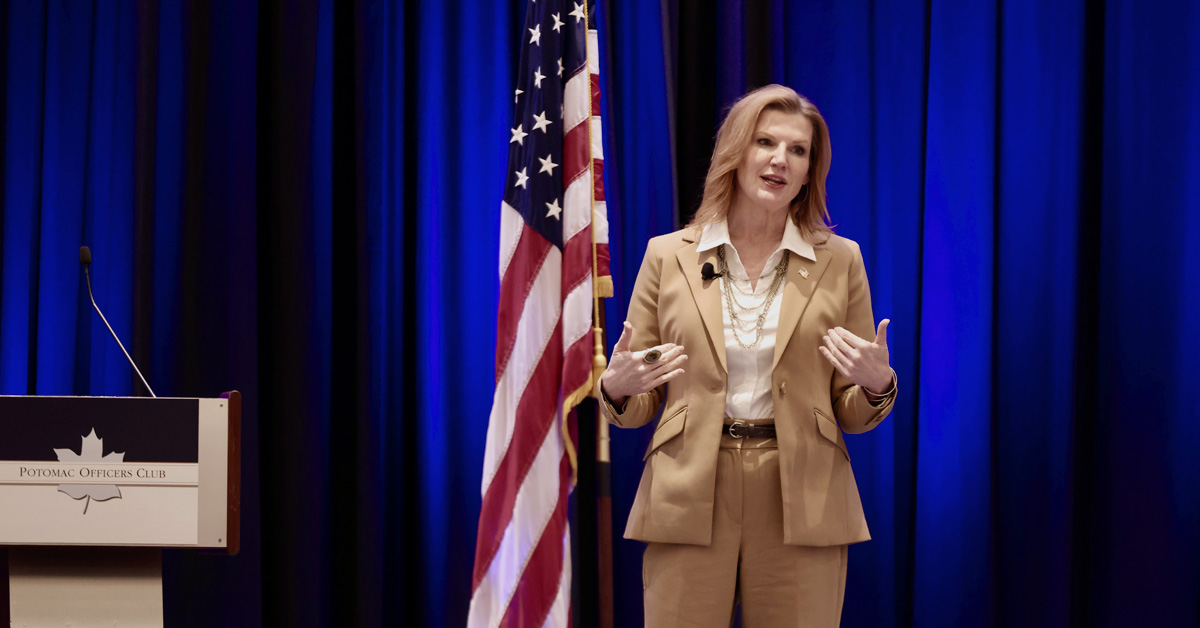
Industry has exemplified the same shift in cybersecurity. Everfox CEO David Wajsgras, honored for the ninth time, has overseen advances in secure cross-domain and zero trust capabilities. Capgemini Government Solutions CEO Dan Ford also won for leading company efforts to deliver zero trust and generative AI security services through its global Cyber Defense Centers.
Space as a National Security Priority
The administration’s December executive order on ensuring American space superiority set a policy agenda to return astronauts to the moon by 2028 and build a national security space architecture capable of detecting and countering emerging threats.
The increased prioritization of space as a contested domain is underscored by Jared Isaacman’s and Gen. Chance Saltzman’s Wash100 wins.
Isaacman’s first Wash100 appearance came after his Senate confirmation as NASA administrator, a role that has since put him in charge of major space initiatives, such as the Artemis program.
Saltzman, a four-time Wash100 winner, is the Space Force’s chief of space operations, responsible for advancing next-generation space warfighting capabilities.
Air Force Under Secretary Matthew Lohmeier, a first-time Wash100 winner, was recognized for advancing warfighter readiness and integrating air and space power. He advocates for investments in resilient space architectures to deny adversaries a first-mover advantage.
The industry is also responding to the increased prioritization of space in defense and national security. SES CEO Adel Al-Saleh, who topped the industry category in this year’s Wash100 Popular Vote, is positioning the company to play a larger role in defense communications and multi-orbit connectivity. Saleh oversaw SES’ $3.1 billion acquisition of Intelsat, growing the company’s fleet to 120 satellites across geostationary and medium Earth orbit. SES is also developing meoSphere, a multi-mission satellite network to support government and commercial missions.

Learn about opportunities to provide advanced capabilities to the U.S. Space Force at the 2026 Air and Space Summit on July 30. The event will convene leaders who oversee the acquisition of space-based technologies, such as Acting Assistant Secretary of the Air Force for Space Acquisition and Integration Tom Ainsworth. Sign up today.
Digital Transformation of Legacy Government Systems
Replacing aging federal IT infrastructure remained a defining challenge in 2026. Federal CIO Gregory Barbaccia was honored for leadership in advancing government-wide IT modernization, improving service delivery and accelerating AI adoption across federal agencies. He has also promoted a one-government approach to purchasing digital services to standardize design and user experience across all government websites.
Customs and Border Protection CIO Sonny Bhagowalia, a two-time Wash100 winner, was recognized for transforming federal agencies through IT. He developed a four-tier strategy to guide his agency’s digital modernization efforts.
From industry, Leidos CEO Tom Bell was recognized for guiding the company’s growth through its NorthStar 2030 strategy, which identifies digital modernization as a key pillar. Leidos won multi-million-dollar contracts from the Air Force and the Defense Threat Reduction Agency to deliver defense modernization support services.
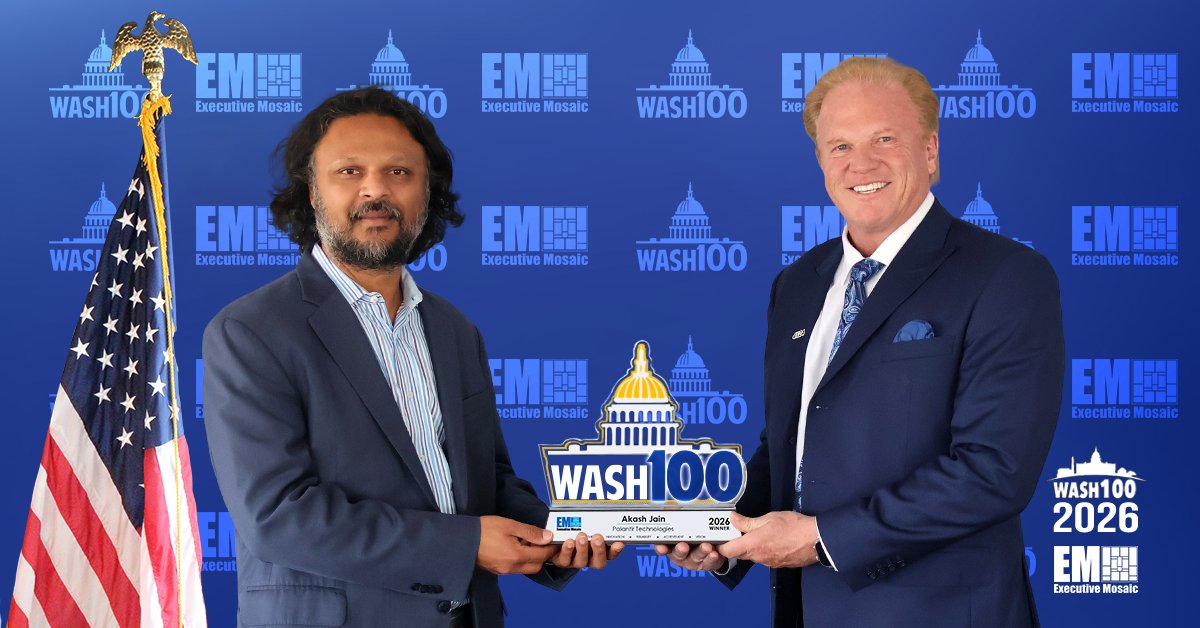
Aki Jain, president and CTO of Palantir USG, earned his second Wash100 for deepening the company’s role in operationalizing AI and modernizing defense data systems. The company has a 10-year enterprise agreement with the Army worth up to $10 billion to provide commercial software.
Why the Wash100 Matters to GovCon
The Wash100 is more than just an individual achievement. While winners are recognized for exemplary leadership or innovative work in their respective fields, the list as a whole provides a clear picture of where GovCon is heading.
When senior government officials and industry executives win the Wash100 for advancing similar initiatives, it is a sign that the public and private sectors are moving on the same timeline and toward the same goal.
The award also creates a record of where government dollars and private sector investment go. Over time, the Wash100 shows a comprehensive look into how priorities and strategies evolve, whether it is the race for AI leadership or achieving superiority in any domain.