
Secretary of State Marco Rubio Wins 2026 Wash100 for Driving AI Strategy & Expanding Drone Export Markets
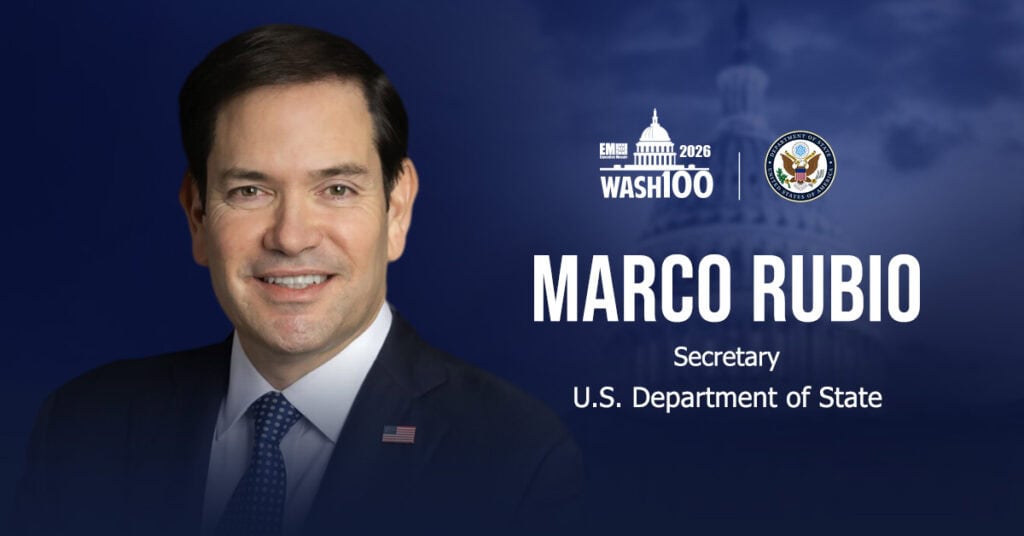
Executive Mosaic is proud to honor Secretary of State Marco Rubio as a 2026 Wash100 Award winner for his leadership in advancing artificial intelligence strategy and opening global markets for U.S. drone exports while strengthening economic and national security alignment.
This marks his second consecutive Wash100 Award, a prestigious accolade given annually to the 100 most influential and impactful leaders across the government contracting industry and the federal government.
Cast your vote for Rubio in the Wash100 popular vote contest!
Why Is Marco Rubio Winning the 2026 Wash100 Award?
“Secretary Rubio’s selection as a 2026 Wash100 Award recipient reflects his forward-looking leadership at a pivotal moment for U.S. economic and national security. He has enabled the GovCon community to better integrate with the international marketplace. This was demonstrated through new markets opened for the U.S. drone industry by his update to the State Department’s unmanned aircraft export policy. Secretary Rubio also championed a proposal to raise dollar thresholds allowing foreign technology sales without congressional review,” said Jim Garrettson, CEO of Executive Mosaic and founder of the Wash100 Award.
“He has embraced artificial intelligence as a core enabler of American competitiveness through the State Department’s Enterprise Data and Artificial Intelligence Strategy for 2026, aligning innovation with mission impact,” Garrettson noted. “Secretary Rubio’s ability to pair strategic vision with decisive action is strengthening both U.S. industry and global leadership. We look forward to his continued impact in the year ahead.”
What Is the State Department?
The State Department is the United States’ lead foreign affairs agency. Led by the secretary of state, the department is responsible for implementing U.S. foreign policy, managing diplomatic relations, overseeing international agreements and advancing national security interests abroad.
Who Is Marco Rubio?
Rubio serves as the 72nd secretary of state, a role he assumed in January 2025 following a unanimous Senate confirmation. He also serves as acting national security adviser.
Before joining the administration, he represented Florida in the Senate for more than a decade after serving as speaker of the Florida House of Representatives.
During his tenure as senator, Rubio held several positions in different committees, including senior member of the Senate Foreign Relations Committee, vice chair of the Senate Select Committee on Intelligence and a member of the Senate Appropriations Committee and Senate Committee on Small Business and Entrepreneurship.
He wrote the Uyghur Forced Labor Prevention Act and co-authored the Hong Kong Relations Act and the VERDAD Act.
He also briefly held additional leadership roles within the administration, including acting administrator of the U.S. Agency for International Development and acting director of the National Archives, before focusing fully on his duties as secretary of state.
Reorganizing the State Department
One of Rubio’s top priorities has been a sweeping reorganization of the State Department aimed at improving efficiency and aligning operations with an “America First” foreign policy framework.
“This approach will empower the Department from the ground up, from the bureaus to the embassies,” Rubio said in a statement. “Region-specific functions will be consolidated to increase functionality, redundant offices will be removed, and non-statutory programs that are misaligned with America’s core national interests will cease to exist.”
Driving AI Adoption in Diplomacy
Under Rubio’s leadership, the State Department has accelerated its embrace of artificial intelligence and data-driven tools.
The department released its 2026 Enterprise Data and Artificial Intelligence Strategy to modernize diplomatic operations, improve decision-making, promote collaboration and future-proof the diplomatic workforce. The initiative aims to integrate AI across mission areas while enabling what officials describe as more advanced, tech-enabled statecraft.
“Winning the AI race is non-negotiable,” Rubio said. “America must continue to be the dominant force in artificial intelligence to promote prosperity and protect our economic and national security.”
In July 2025, the White House issued its AI Action Plan, outlining over 90 federal policy actions across three pillars: accelerating AI innovation; building American AI infrastructure; and leading in international AI diplomacy and security.
“These clear-cut policy goals set expectations for the Federal Government to ensure America sets the technological gold standard worldwide, and that the world continues to run on American technology,” Rubio said of the action plan.
Expanding Global Policy Initiatives
With Rubio at the helm, the State Department has launched several major policy efforts, including the America First Global Health Strategy, a framework that seeks to strengthen U.S. leadership in global health while prioritizing American safety, economic resilience and international partnerships.
“We will continue to be the world’s health leader and the most generous nation in the world, but we will do so in a way that directly benefits the American people and directly promotes our national interest,” Rubio said.
Rubio has also led a shift in how the U.S. approaches foreign assistance, with the department working to streamline funding structures, reduce bureaucratic barriers and introduce more flexible, mission-aligned delivery models. The strategy emphasizes accountability, measurable outcomes and stronger alignment with U.S. strategic priorities.
“By empowering diplomats on the ground through regional bureaus, we are creating a fast feedback loop to ensure programs align with American interests and the needs of partner nations,” he said.
In September, the secretary approved an update to the U.S. government’s policy on the export of unmanned aerial systems in accordance with an executive order seeking to introduce reforms to the foreign defense sales system.
In a fact sheet, the State Department’s Bureau of Political-Military Affairs said the department will review drone export requests similar to how it evaluates requests to export manned fighter jets.
Advancing Mission-Focused Contracting
Rubio’s strategic priorities are also reflected in State Department procurement activity.
The department has advanced major contracts and opportunities supporting IT modernization, cybersecurity, AI-enabled defense systems and global infrastructure. High-value awards and contract vehicles underscore a shift toward mission-aligned acquisition strategies designed to address emerging threats and operational demands.
These include the award of the $5 billion GLOBALCAP contract vehicle that aims to support U.S. foreign policy initiatives worldwide to strengthen peace, security and regional stability; the selection of eight vendors for up to $2.7 billion in facility operations and maintenance contracts; and the award of the potential $8 billion Evolve indefinite-delivery/indefinite-quantity contract for network and telecommunication services.
The State Department recently issued a notice to solicit information on potential industry sources that could provide IT support services under a potential five-year, follow-on blanket purchase agreement.
Leading Diplomatic Transformation & Strategic Alignment
Rubio’s tenure as secretary of state has been defined by structural reform, technological modernization and a renewed focus on strategic alignment.
From reorganizing the department and accelerating AI adoption to strengthening global policy frameworks, Rubio is reshaping how the U.S. conducts diplomacy in an increasingly competitive world.
Executive Mosaic congratulates Secretary Marco Rubio on his second Wash100 Award recognition.
Vote for Rubio in the 2026 Wash100 popular vote competition.