
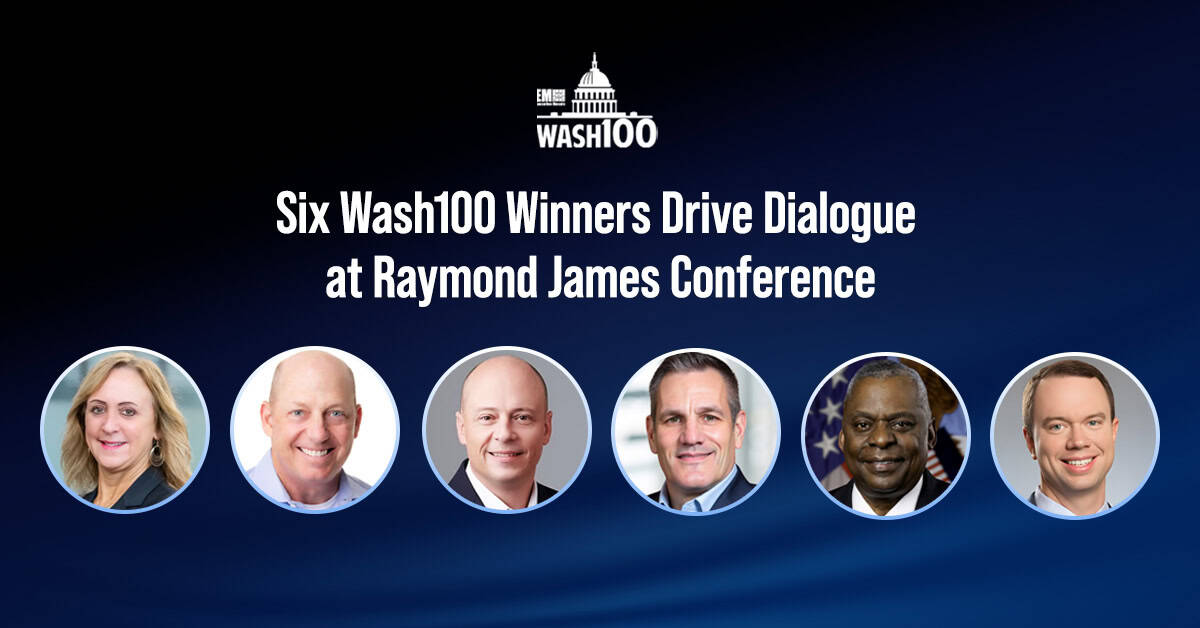
Raymond James’ 2025 Defense & Government Conference brought together leaders shaping the future of defense technology, policy and acquisition reform. Held Oct. 16 at Nationals Park in Washington, D.C., the event underscored how government contractors are adapting to a rapidly changing threat landscape — and how Wash100 Award-winning executives are driving that evolution.
Among the attendees were Parsons CEO Carey Smith, Amentum CEO John Heller, Cubic CEO Stevan Slijepcevic, Arcfield CEO Kevin Kelly, Raymond James’ Sam Maness and former Secretary of Defense Lloyd Austin — all Wash100 Award winners — alongside Executive Mosaic 4×24 Leadership Group members Damian DiPippa of Auria Space and Katie Selbe of GRVTY.
Want to hear from another prominent and industry-defining leader on how her agency is partnering with contractors? Attend the 2025 Homeland Security Summit on Nov. 12, where DHS Sec. Kristi Noem will offer a keynote address. Register for this GovCon networking event today!
1. The Defense Industry Is in a “Revolution”
Brian Gesuale, managing director of Raymond James Equity Research and moderator of The Warfighter’s Edge: Defense Technology Company Perspectives panel, opened with a challenge to the GovCon sector: adapt fast or get left behind.
“The defense industry is going through a bit of a revolution,” Gesuale said, adding that contractors need to evolve alongside the changing nature of warfare.
Panelist Wahid Nawabi, CEO of AeroVironment, described a future where robotics dominate modern conflict.
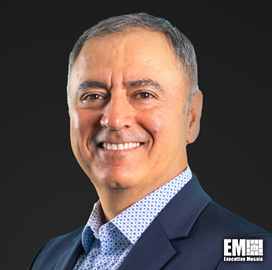
“The war of the future, the conflict of the future, is going to be a lot of robotics,” Nawabi said. “Assets against assets, trying to prove who’s got more power, who’s got more superiority and then maybe…there’s less lives probably lost in the process. So that could be the new sort of reality of what a war really is instead of…a lot of casualties at the front line. I think that’s a very, very realistic scenario that could happen in the next few years.”
That prediction aligned with Gesuale’s view: technology innovation will define the warfighter’s edge in coming years.
2. Acquisition Reform Is Still the Biggest Bottleneck
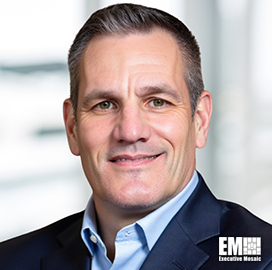
Cubic CEO Stevan Slijepcevic, a two-time Wash100 winner (2022 and 2023), described how Cubic is rethinking development — moving away from massive, slow programs and toward smaller, customer-driven iterations.
He said Cubic now focuses on “smaller increments” and “iterative development with customers,” running pilots in real operational environments to accelerate time to market.
But Slijepcevic noted that bureaucracy, not technology, remains the real obstacle.
“The biggest barrier of risk is really just the acquisition process,” he said. “Innovation is too slow, and bringing capabilities to warfighters is too slow. It’s not a technology barrier, it’s a process barrier.”
He echoed comments made earlier this month by U.S. Army Secretary Daniel Driscoll at AUSA’s 2025 annual meeting, calling for sweeping reform to accelerate acquisition for tech-enabled systems.
3. Global Growth & Resilience Define Parsons and Amentum Strategies
During the Driving the Mission: Public Government Solutions Company Perspectives session, Parsons CEO Carey Smith and Amentum CEO John Heller laid out strategies that combine global diversification with mission-critical innovation.
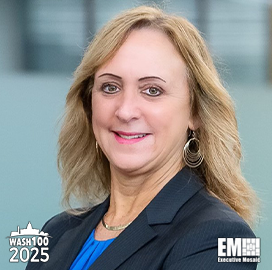
Smith, a seven-time Wash100 awardee, said Parsons has “purpose-built” its portfolio since 2016 for full-spectrum operations in cyber, electronic warfare, selective space programs and missile defense.
“We have positioned ourselves for the environment we’re in,” Smith said. “We’ve purpose-built our portfolio since 2016 to cover full-spectrum operations in cyber, electronic warfare, selective areas of space and missile defense.”
She highlighted rapid expansion in the Middle East — now 17 percent of Parsons’ business — with projects like Saudi Arabia’s Qiddiya, King Salman Park and Diriyah Gate, plus major metro builds in Riyadh and Dubai.
“We can take technology and capabilities that we have there and bring them back to the U.S. and Canada,” Smith added.

Heller, who has led Amentum through nine consecutive Wash100 wins, pointed to the company’s focus on space superiority and AI-driven infrastructure.
“Having leadership in AI in the world is a national security issue,” Heller said. “We need more data centers built at an unbelievable capacity… and new power capability with SMRs and gigawatt nuclear plants in the U.S. and Europe.”
Both leaders underscored their firms’ resilience through geopolitical shifts. Heller also shared that Amentum has a healthy, 6,000-strong workforce in the U.K. and has been involved in every one of the nation’s nuclear power plant builds.
“We see our work outside the U.S. as enduring regardless of what’s happening here,” Heller said.
4. The Next Frontier: Space, Cyber and Integration
The Space Intelligence and Golden Dome: Innovation at the Final Frontier panel spotlighted the rapidly converging fields of space, cyber and intelligence.
Arcfield’s Kevin Kelly, a 2024 Wash100 awardee, said the Golden Dome initiative — the new U.S. space-based defense architecture led by (yet another Wash100 recipient) Gen. Michael Guetlein — is “not as much of a technical challenge as it is an integration challenge.”

Kelly stressed the importance of resiliency and redundancy across systems, while Auria Space CEO Damian DiPippa emphasized the complexity of C3 under Golden Dome.
“Probably one of the biggest challenges [Gen. Guetlein has to] tackle up front is the command and control and communication side,” DiPippa said. “There are multiple systems going together that have to work.”
GRVTY CEO Katie Selbe forecasted the next wave of value creation in seamless domain integration.
“Integrating the cyber layer and having it work flawlessly — whether you’re in space or on the internet — is going to be where the next value creation is,” Selbe said. “Companies that can operate across the ‘ints’ — SIGINT, COMINT, ELINT — will be the winners.”
Learn more about how to Build a Resilient Homeland Security Enterprise Through AI-Driven Cyber Defense during the panel at Potomac Officers Club’s 2025 Homeland Security Summit on Nov. 12! Experts will share usable strategies and projections about future DHS cyber tech needs. Save your spot before they sell out.
5. Lloyd Austin on Leadership, Allies & Preparedness
A fireside chat between former Secretary of Defense Lloyd Austin and Raymond James Managing Director Sam Maness closed the pre-lunch sessions on a note of global awareness and leadership wisdom.
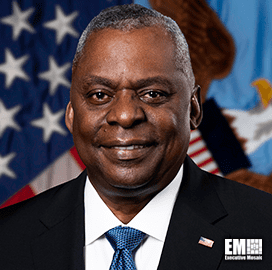
Austin, a three-time Wash100 winner, drew from decades of command experience.
“Troops will perform in the real deal, in combat, as you train them in garrison,” Austin said. “Be compassionate yet demanding.”
He emphasized the importance of alliances, particularly lessons learned from the Ukraine conflict and Israel’s intelligence preparedness.
“One of the things characteristic of the Israeli forces is that they have one of the world’s best intelligence organizations… Having said all that, the Israelis were surprised by the attack by Hamas… It drives home the importance of intelligence and preparation of the battle space.”

He continued, “I don’t think in our lifetime we’ll ever see Israel be surprised on anything that involves intelligence matters ever again. But in this instance, they were surprised. And it rocked them back,” he said of the Oct. 7, 2023 aggression from Hamas.
Austin discussed ongoing global conflicts, from Sudan’s civil war to broader threats from China and Russia, urging caution against framing competition with China as a “new Cold War.”
He also reaffirmed his belief in the enduring power of alliances through AUKUS, the trilateral partnership between Australia, the U.K. and the U.S.
“AUKUS enables Australia, the Philippines and Japan to work together in a more capable way in anticipation of the China threat,” Austin said.
The Bottom Line
Across technology, acquisition, space and strategy, this year’s Raymond James Defense & Government Conference showcased the GovCon community’s ability to adapt to disruption while strengthening global partnerships.
For Wash100 leaders like Smith, Heller, Slijepcevic, Kelly, Maness and Austin — and Executive Mosaic’s rising 4×24 figures DiPippa and Selbe — innovation, integration and leadership remain the throughlines shaping the defense sector’s next chapter.
Note: Two more Wash100 winners — JD Parkes of Parry Labs and Peter LaMontagne of SMX — spoke in the afternoon sessions at the conference but our media team was not in attendance.