

DISA Director Lt. Gen. Paul Stanton Wins 2026 Wash100 Award for Driving DOW Network Modernization, Cyber Defense Strategy
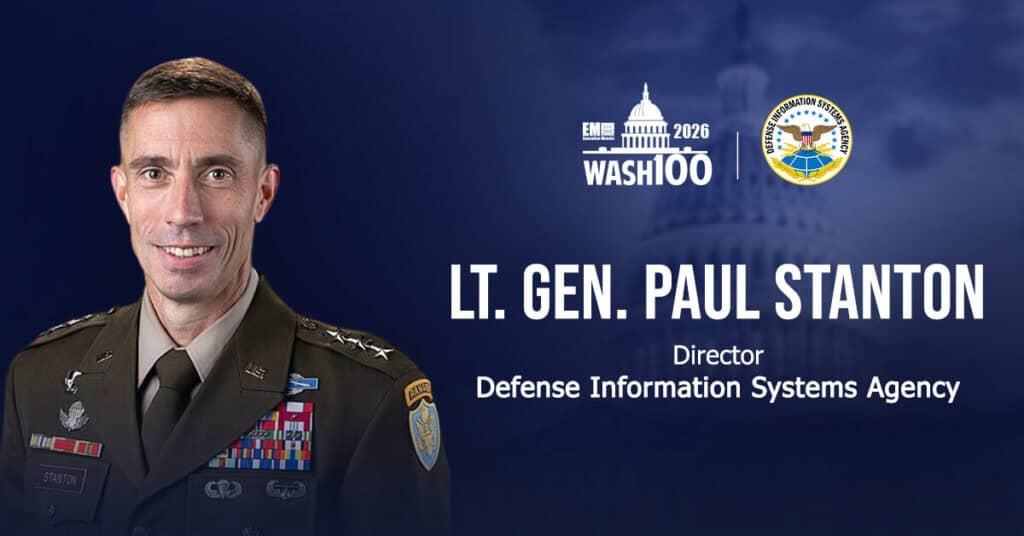
Executive Mosaic is honored to announce Lt. Gen. Paul Stanton, director of the Defense Information Systems Agency and commander of the Department of War Cyber Defense Command, as a 2026 Wash100 Award recipient in recognition of his leadership in advancing enterprise IT modernization, strengthening cyber defense operations and accelerating secure data delivery across DOW.
Support Stanton in the 2026 Wash100 popular vote competition.
Why Is Lt. Gen. Paul Stanton Winning the 2026 Wash100 Award?
Stanton has earned the 2026 Wash100 recognition for leading DISA’s efforts to modernize the Department of War Information Network while reinforcing a proactive, warfighting-oriented cyber defense posture.
Since assuming the role in October 2024, he has emphasized delivering “the right data to the right place at the right time,” aligning DISA’s enterprise IT services with operational decision-making requirements across combatant commands.
“Lt. Gen. Stanton has built a distinguished 30+ year Army career, including serving as commanding general of the Army Cyber Center of Excellence—where he led cyber and signals intelligence modernization—and as deputy director of operations at U.S. Cyber Command, helping integrate the Pentagon’s cyber capabilities,” said Jim Garrettson, CEO of Executive Mosaic and founder of the Wash100 Award.
“Lt. Gen. Stanton’s experience positions him well to lead the Defense Information Systems Agency. He has already strengthened defensive cyber operations, improving risk management and prioritization of critical systems. Lt. Gen. Stanton’s first Wash100 Award is well deserved, and we expect even greater impact in 2026,” added Garrettson.
What Is DISA?
DISA is a combat support agency within DOW that provides enterprise IT, communications and cybersecurity services to support military operations worldwide. It operates and defends the DOW Information Network while delivering secure data and communication capabilities to warfighters, leaders and mission partners.
The agency also manages cloud, data, identity and network infrastructure across the department and leads efforts in cybersecurity, zero trust and IT modernization.
Supporting Mission-Critical Contracts & Capabilities
DISA’s priorities under Stanton have been reflected in a series of major contract awards and initiatives supporting enterprise IT and cyber capabilities.
Recent awards include Leidos’ $142 million contract to modernize the IT operations of DISA’s Compartmented Enterprise Services Office; MTSI’s potential $416 million contract supporting Air Force Global Strike Command technology integration; and a potential $931 million other transaction agreement to advance data center modernization under the Defense Cloud Instance initiative.
Additional efforts include Amentum’s $120 million contract for Z-series processing capacity services and a $98 million DISA contract modification awarded to GDIT for continued communications systems support.
Who Is Lt. Gen. Paul Stanton?
Stanton is a senior military leader with extensive experience in cyber operations and enterprise IT.
Prior to becoming DISA director, he was commanding general of the U.S. Army Cyber Center of Excellence at Fort Eisenhower in Georgia. He also served as deputy commanding general of operations at Army Cyber Command and commanding general of the Cyber Center of Excellence.
He also held a number of joint, staff and command positions, including director of capabilities development group at U.S. Cyber Command, commander of the Army Cyber Protection Brigade and senior technical adviser at Army Cyber Command.
Advancing Enterprise IT & Network Modernization
At DISA’s Forecast to Industry event, Stanton called for stronger collaboration with industry partners to deliver integrated, mission-ready capabilities to warfighters. He outlined priorities including readiness, campaigning, continuous modernization and lethality, stressing that success depends on delivering “functionally relevant capability” rather than isolated tools. Stanton said solutions must integrate transport, security, compute and data to address real operational needs, underscoring that close coordination between government and industry is essential to achieving outcomes at speed and scale.
Under Stanton’s leadership, DISA has pushed to transform enterprise infrastructure through initiatives such as the DODNet modernization effort, which sought to strengthen the network and help warfighters address emerging threats by integrating advanced technologies.
In 2025, the agency rolled out a cloud management platform, Olympus, to help DOW agencies manage and scale cloud environments and announced plans to expand the Joint Enterprise License Agreement program to achieve cost savings.
These efforts align with DISA’s data strategy, establishing the foundation for improving the agency’s cybersecurity posture, optimizing its network and leveraging artificial intelligence, machine learning and other emerging technologies to support warfighters.
Strengthening Cyber Defense & Zero Trust Implementation
A central pillar of Stanton’s leadership has been shifting cyber defense toward a proactive, mission-focused model that prioritizes critical assets and operational outcomes rather than attempting to defend all systems equally.
Stanton has urged cyber professionals to shift from a reactive cyber incident response to a proactive mindset to better protect DOW’s information network from adversaries.
“Don’t randomly chase incidents. Don’t chase events. Think in context. Think about what the enemy is attempting to accomplish. Think about what missions are relevant to us. Think about where our missions and the enemy’s intent and capabilities overlap, and in the center of that Venn diagram, build your engagement area, and then beat the enemy,” the lieutenant general said.
DISA has supported this approach through the development of custom analytics tools for cyber defenders, enabling faster threat detection and response within operational environments. The agency also has advanced efforts to advance zero trust implementation through federated identity, credential and access management.
Additionally, DISA has introduced a cross-domain transfer system to enable secure data sharing and support DevSecOps efforts. The agency has also fielded the EndGuard cyber defense tool to protect vulnerable endpoints in support of the Navy Readiness Reporting Enterprise.
At the inaugural DOD Cyber Workforce Summit, Stanton underscored that maintaining an advantage in cyberspace requires both technical mastery and a “warrior ethos.” He described cyber as an active battlespace where the U.S. must rely on highly skilled personnel, urging professionals to develop deep expertise in coding, algorithms and networking while continuously updating their skills to keep pace with evolving threats. In this event, Stanton reiterated the need for a proactive mindset—anticipating and disrupting adversaries rather than reacting—and called for modernized workforce models and earlier education pipelines to build future cyber talent.
He also highlighted ongoing coordination with the Army to strengthen joint cyber operations. He said resolving challenges at lower levels allows senior leaders to focus on strategic priorities, reinforcing collaboration and integration across DOW. The effort reflects a broader push to improve unity of effort and operational effectiveness as cyberthreats continue to evolve.
Driving Data Strategy & Workforce Development
Stanton has reinforced the importance of data as a strategic asset through initiatives such as DISA’s Data Lifecycle Management Guidebook, which aims to help manage data assets and ensure compliance with regulatory standards.
Stanton emphasized workforce development, underscoring the need to build a talent base with the skills required to operate effectively in a data-centric environment.
He also challenged cyber professionals to better communicate their domain to the broader warfighting community, urging them to use clear, relatable language. “If you don’t get gas, you don’t move. If you don’t have data, then you can’t call for fire,” he said.
Stanton made an urgent push to recruit IT and cybersecurity professionals, telling attendees at a February hiring event that he was seeking to fill dozens of positions critical to national defense. The event featured accelerated hiring authorities, with on-the-spot interviews conducted by dozens of managers and multiple contingent job offers extended, as Stanton emphasized that DISA’s mission is not routine IT work but operating a “weapons system” in support of national defense. He highlighted a culture rooted in mission command, encouraging innovation, initiative and problem-solving to attract talent motivated by purpose and service.
Shaping DOW’s Digital Warfighting Edge
Stanton’s Wash100 recognition highlights his role in transforming DOW’s enterprise IT and cybersecurity posture. By aligning technology modernization with operational priorities and advancing secure, data-driven decision-making, he continues to shape how the department delivers digital capabilities to the warfighter.
Executive Mosaic congratulates Lt. Gen. Paul Stanton and the entire DISA organization on their 2026 Wash100 Award recognition.
Show your support for Stanton in the 2026 Wash100 popular vote competition.