- A new EO and the FY2026 NDAA introduced defense acquisition rules covering supply chains
- Five compliance milestones are taking effect between 2026 and 2031
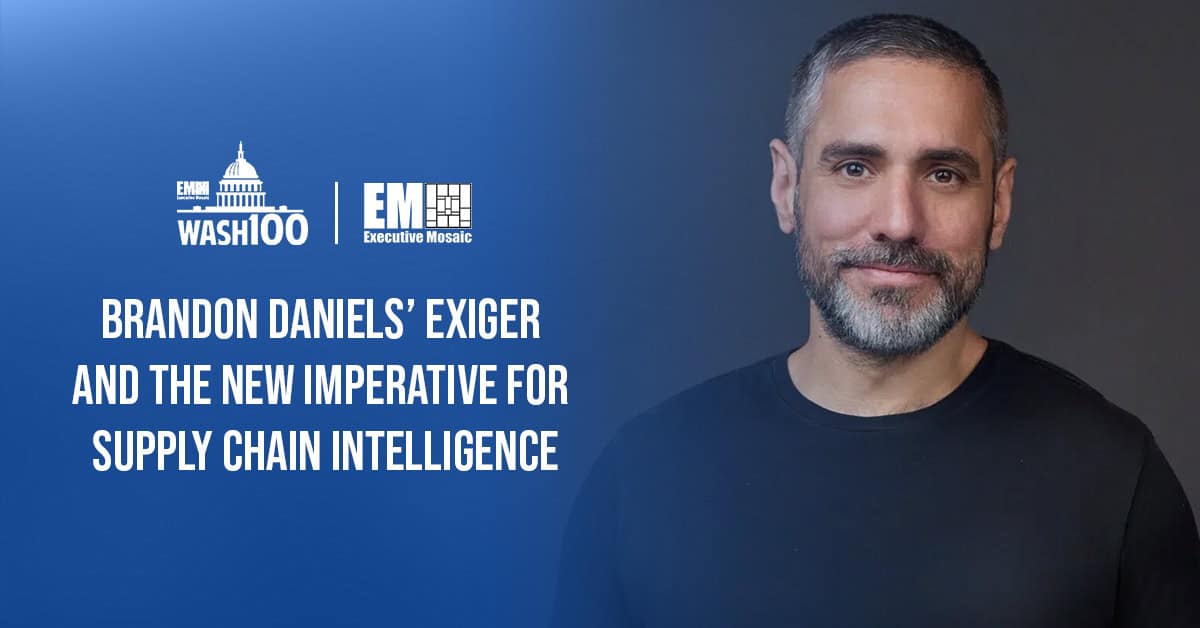
- Exiger, led by 2026 Wash100 winner Brandon Daniels, provides AI-driven supply chain visibility tools
Expanding foreign entity of concern, or FEOC, restrictions and new Department of War expectations for supply chain visibility are creating new requirements for the defense industrial base. The shift is driven by the government’s increased focus on resilience and the need to protect critical military and national security systems from vulnerabilities to material shortages and adversary influence.
Exiger, led by 2026 Wash100 winner Brandon Daniels, is offering advanced tools to expand supply chain visibility.
What Does Exiger Provide to Government Customers?
1Exiger charts multi-tier dependencies, providing organizations with a full look at potential vulnerabilities, and traces country of origin or record of transshipments to ensure compliance.
The company recently launched 1Exiger.AI, an AI-native upgrade to 1Exiger that introduces autonomous agent capabilities for supply chain, trade management, procurement, readiness and compliance. 1Exiger.AI is built to serve as a centralized system for tracking suppliers, parts, regulatory obligations and customer relationships.
“1Exiger will be like the smartphone of supply chain, readiness, and trade management, with new versions seamlessly deployed for an ever-improving experience,” Daniels said about the product.
In November 2025, the company secured a contract from the Army to license its 1Exiger platform to enhance the monitoring and orchestration of sustainment activities, including fires and munitions, ground combat, aviation and communications.
Exiger also won a spot in the potential 10-year, $919 million Supply Chain Risk Illumination Professional Tools and Services, or SCRIPTS, blanket purchase agreement for the acquisition of supply chain risk illumination tools and analytic services. The BPA, administered by the General Services Administration, provides the Department of War and federal civilian executive branch agencies with access to tools for vendor vetting, cyber hygiene and foreign ownership control and influence.
Exiger is also providing its Trade AI platform to the U.S. Customs and Border Protection under an exclusive contract awarded in October 2025. The deal supports the detection of illicit transshipment in global supply chains.
What Are the New Rules Governing Defense Acquisitions?
In July, President Donald Trump signed Executive Order 14415, Securing America’s Defense Supply Chains and Ensuring Domestic Acquisition of Critical Materials. Designed to reduce reliance on adversary nations and to strengthen domestic supply chains, the EO mandates that contractors map their supply chains and restricts the issuance of waivers for covered critical materials.
The National Defense Authorization Act for Fiscal Year 2026 adds its own set of rules that further limit purchases from FEOC, defined as companies located in or controlled by China, Russia, Iran or North Korea. The law covers batteries and minerals used in weapons and other defense systems.
What Are the Dates Contractors Must Know?
1. Source Qualification Strategy Due Mid-October
The order gave War Secretary Pete Hegseth, a two-time Wash100 winner, 90 days to develop a strategy that would speed up testing and qualifications of new sources and materials for prime contractors and subcontractors. The president also authorized Hegseth to rescind regulations that impede rapid testing and qualification for defense production, DefenseScoop reported.
2. Stricter Critical Material Waiver Requirements Take Effect on Jan. 1, 2027
By Jan. 1, 2027, the Pentagon will stop issuing waivers for the acquisition of covered materials, unless the contractor or subcontractor submits a mitigation plan that identifies sources of noncompliant materials, efforts made to obtain compliant materials and strategies for removing noncompliant materials from the supply chain. The contractor and subcontractor must also provide a timeline to achieve full compliance.
According to the EO, failure to qualify a domestic source is not a valid reason to secure a waiver unless the contractor has demonstrated active, funded efforts to qualify or develop one. Furthermore, the DOW may pursue contractual remedies or refer contractors to the attorney general for failure to execute an approved mitigation plan.
3. Supply Chain Mapping Guidance Out by January 2027
The EO gave the war secretary 180 days to develop policy and guidance for prime contractors and subcontractors to map supply chains of all DOW acquisitions that may impact national security. Per the EO, defense contractors will need to submit a complete bill of materials that details raw material origins and establish a supplier and subcontractor vetting process.
SecurityWeek reported that the regulation is broader than a standard software bill of materials, or SBOM. The new rule links software and firmware dependencies to components, manufacturers and suppliers, maintenance, countries of origin, and sources of raw materials.
4. Gallium and Germanium Restrictions Take Effect Dec. 18, 2027
The FY 2026 NDAA prohibits military components and defense agencies from purchasing gallium and germanium from non-friendly countries.
Defense contractors use germanium to manufacture infrared optics, night vision systems, surveillance windows, thermal weapon sights and other electro-optical/infrared equipment. Meanwhile, gallium is used in high-performance semiconductors that power defense systems, such as radars for aerial and maritime platforms and EO/IR sensors in missile guidance.
5. FEOC Battery Procurement Limits Begin Jan. 1, 2028
FY 2026 NDAA limits the Pentagon’s purchase of batteries from companies located in or controlled by FEOC countries. The restrictions take effect on Jan. 1, 2028, for new contracts, while existing acquisition programs must comply by Jan. 1, 2031.