

Pentagon FutureG Director Thomas Rondeau Wins 1st Wash100 for Advancing Defense Wireless Innovation
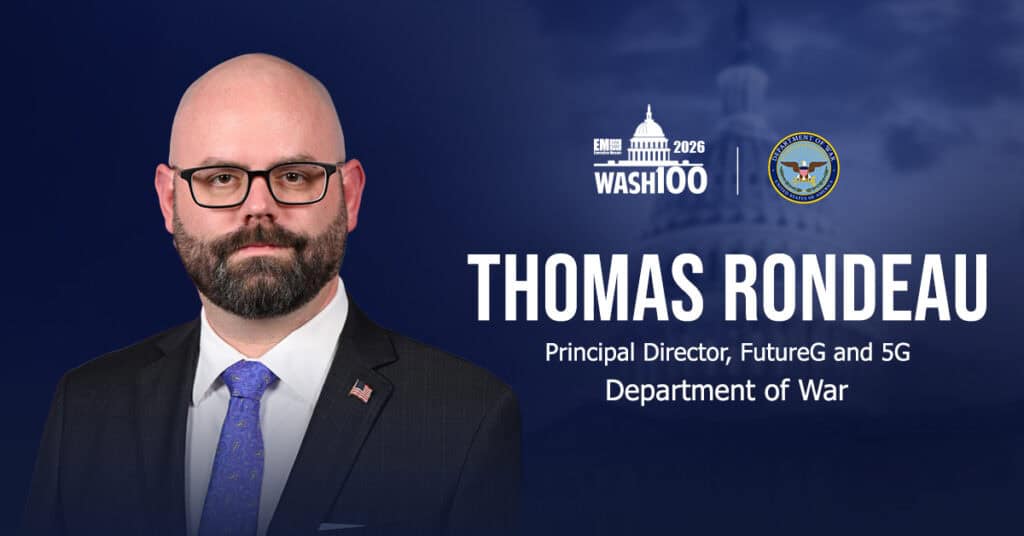
Executive Mosaic is proud to recognize Thomas Rondeau, principal director for FutureG within the Office of the Under Secretary of Defense for Research and Engineering, as a 2026 Wash100 Award winner. A first-time honoree, Rondeau is being recognized for his leadership in advancing next-generation wireless capabilities that will shape the future of military communications and national security.
Now it’s your turn to recognize his impact. Cast your vote for Rondeau in the Wash100 Popular Vote Competition.
Why Is Thomas Rondeau Winning the 2026 Wash100 Award?
Dr. Rondeau is receiving the 2026 Wash100 Award for his influential role in advancing the Pentagon’s FutureG priorities at a time when secure, resilient connectivity has become increasingly vital to national defense. As the Department of War continues modernization efforts and explores next-generation wireless capabilities, Rondeau has helped lead initiatives aimed at moving FutureG concepts from research and experimentation toward defense-relevant applications.
“Dr. Rondeau’s recognition as a 2026 Wash100 Award winner—his first Wash100 honor—is a meaningful tribute to the powerful leadership and burgeoning innovation he is bringing to the Pentagon. As principal director of the Department of War’s FutureG office, we were pleased to have him as a keynote at the 2026 Defense R&D Summit. The audience appreciated his expertise and the depth and relevance of his presentation, said Jim Garrettson, CEO of Executive Mosaic and founder of the Wash100 Award.
He has emphasized the importance of expanding experimentation and development to evaluate emerging wireless technologies and strengthen communications capabilities across the department. Rondeau has also highlighted concepts such as integrated sensing and communications, which could allow future networks to support both connectivity and sensing applications that enhance situational awareness and mission effectiveness. Through these efforts, he continues to help drive DOW’s FutureG modernization agenda and support the department’s broader push for next-generation connectivity.
“Tom has played a key role in shaping the path forward for 5G and next-generation wireless capabilities, helping ensure secure connectivity and technological advantage for warfighters and allies. With his deep technical expertise, strategic mindset and collaborative approach, Rondeau truly embodies the Wash100 spirit and signals an exciting future of impact across GovCon and national security,” added Garrettson.
What Is the DOW FutureG Office?
The FutureG office within the Office of the Under Secretary of Defense for Research and Engineering is responsible for advancing the department’s next-generation wireless priorities. It guides experimentation, research and development efforts tied to FutureG technologies that could strengthen national security and improve defense communications. The office also works with industry and other stakeholders to evaluate emerging wireless capabilities and explore how future networks can be applied to defense missions.
FutureG Priority Programs: OCUDU & ISAC
Under Rondeau’s leadership, the FutureG Office is advancing major initiatives that support next-generation wireless experimentation and emerging 6G development. One key effort is the Open Centralized Unit / Distributed Unit, or OCUDU, project, an open-source platform for 6G that started in 2025.
“The purpose of OCUDU is to get people out of the RAN [or radio access networks] and stop focusing so much on the internal code of the RAN that we’ve been doing for the past 40 years, and start focusing on how you deploy networks in various scenarios and how you use them for interesting, novel applications, specifically how you enable AI at the edge of the networks,” Rondeau told GovCon Wire in an exclusive interview ahead of his keynote speech at the Potomac Officers Club’s 2026 Defense R&D Summit.
Another major area of focus is integrated sensing and communications, or ISAC, which Rondeau described as being “all about turning our networks into sensors.”
“We’ve been running a series of events and workshops and building an industry coalition around ISAC. Two of the key application areas we’re looking at are critical infrastructure protection and border protection,” he said in the same interview.
Scaling FutureG Through OBBBA Funding
Rondeau’s office is preparing to accelerate its FutureG efforts through $500 million in One Big Beautiful Bill Act funding, which he described as “not appropriated money — just money in the Treasury for us to go and run with.”
Rondeau said the FutureG Office will gain access to the funding beginning in fiscal year 2027, with the money expected to be spent across FY 2027 and FY 2028 and into 2029. “This year,” he said, “is all about planning for that execution.”
He added that his team is laying the groundwork to move quickly once the funding becomes available.
“We want to go fast. This year, we’re doing all the due diligence. We’re talking to industry, listening to industry, and making sure we’re putting together the right set of projects to really spur on the 6G ecosystem within the United States, and a lot of work with our international allies and partners,” Rondeau noted.
Who Is Thomas Rondeau?
Rondeau is a senior defense technology leader currently serving as DOW’s principal director for FutureG. In this capacity, he oversees research, funding and implementation of programs supporting warfighting capabilities through future generation wireless technologies, while advancing next-generation wireless networking concepts in support of national security.
He previously spent more than six years as a program manager at the Defense Advanced Research Projects Agency, where he led programs focused on advanced communications technologies. Some of the programs he oversaw include the Arrays at Commercial Timescales – Integration & Validation; Hedgehog; Domain-Specific System on Chip; and Data Protection in Virtual Environments.
Rondeau also brings extensive academic and technical expertise to his current position. He previously led the GNU Radio project, worked as a visiting researcher at the University of Pennsylvania and served as an adjunct with the IDA Center for Communications Research. He earned his Ph.D. in electrical engineering from Virginia Tech, where his dissertation received the Outstanding Dissertation Award in math, science and engineering. He also authored a book on cognitive radio.
Highlighting the Need for Dynamic Spectrum Sharing
Rondeau has emphasized the growing importance of dynamic spectrum sharing, or DSS, as demand increases for access to limited spectrum resources. He noted that DSS is designed to balance the needs of multiple stakeholders by ranking security and capacity requirements and allocating spectrum dynamically. “It’s a question of balancing those degrees of freedom, and of each individual user’s desire for the capacity that they want to be able to utilize,” Rondeau said. “Basically, it’s a very complicated scheduling problem.”
He noted that artificial intelligence and machine learning could play an increasing role in managing spectrum access in real time.
Advocating a Software-Centric Approach to 6G Leadership
Rondeau has emphasized publicly that the race to 6G will be shaped not only by hardware advances, but by leadership in software and standards.
In a LinkedIn post following his keynote appearance at the 2026 Defense R&D Summit, he said the event provided an opportunity to discuss “the critical role of software in the global race for wireless leadership.”
He added that the U.S. is “at a pivotal moment,” noting that “the nation that leads in 6G software and standards will have a significant economic and national security advantage.”
Rondeau said the FutureG office is focused on driving a software-centric approach through initiatives such as OCUDU, which he described as an effort to foster “an open, programmable ecosystem” that can drive innovation and help ensure warfighters maintain advanced and secure communications capabilities.
Wash100 Recognition for FutureG Leadership
As one of the key leaders helping shape the Pentagon’s FutureG direction, Rondeau has earned his place among the Wash100 elite. His efforts to strengthen FutureG experimentation and advance next-generation connectivity initiatives reflect the kind of forward-looking leadership that defines the Wash100 Award. Executive Mosaic congratulates Rondeau for this remarkable achievement.
Vote for Rondeau in the Wash100 Popular Vote Competition.