

Co-authored with Pat Host
For eight years, investment banking firm Baird has brought the government contracting community a sterling conference every November to take the pulse on the industry’s current state of mind. Panel sessions, company presentations and fireside chats complement dispatches directly from Baird experts that review statistics and projections, growth trends and market behavior diagnoses.
This year’s 2025 Defense & Government Conference was held on Nov. 18 at the Ritz-Carlton, Tysons Corner in Virginia (which the organization revealed would no longer be its home going forward—the event will be hosted downtown in Washington, D.C. starting in 2026). Executive Mosaic attended and covered the event, offering instantaneous social media dispatches, recording video interviews and sitting in on many of the sessions. Many Wash100 winners could be seen in both the audience and onstage throughout the day. Here’s what we learned.
Many of the key topics at the Baird conference — such as AI, DOD acquisition reform and defense tech — will be further explored at Potomac Officers Club’s 2026 Defense R&D Summit. This is the first POC event of the year; you don’t want to miss it! Featuring a keynote from none other than the Pentagon’s chief technology officer, Under Secretary of Defense for Research and Engineering Emil Michael. Register here for the GovCon networking event.
What Were the Main Discussion Points at Baird’s 2025 Defense & Government Conference?
Defense Tech Is King
Throughout the conference, the prevalence of defense technology — which Raft CEO and Wash100 recipient Shubhi Mishra in her company presentation defined as “tech that helps warfighters and operators and makes them superwarfighters” — was undeniably the focal point of most discussions. Disruptive companies that produce innovative, often unmanned and software-based tools were framed as ascendent in the marketplace, competing with and potentially displacing larger prime contractors.
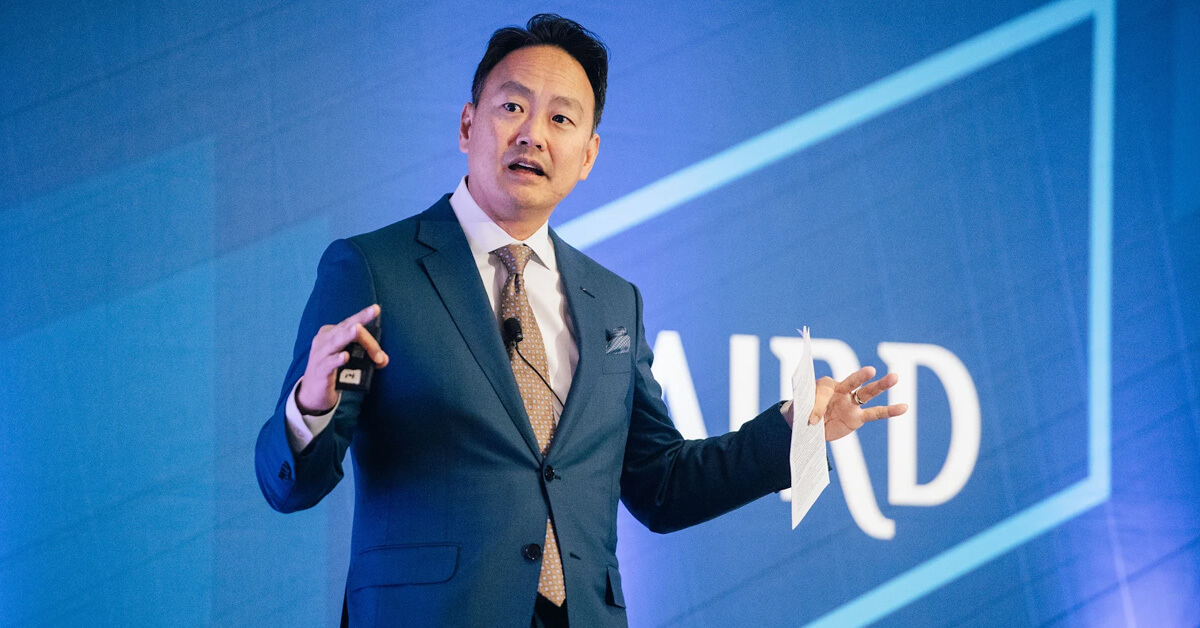
In their opening State of the Market address, Baird managing directors, Wash100 Award winners and event hosts Jean Stack and John Song said that defense tech is growing at an astronomical rate, projected at a growth index of 129 percent in the last year. For instance, AV was trading at $156 per share, then raised $1.8 billion in a follow-on offering earlier in 2025 and is now at $291 per share — an 86 percent increase. Likewise, Kratos Defense & Security Solutions collaborated with Baird to raise $575 million and grew 175 percent to $72 a share.
“Public markets have been super supportive of the defense tech market and we’re really seeing the growth that is in front of them even today,” Song emphasized.
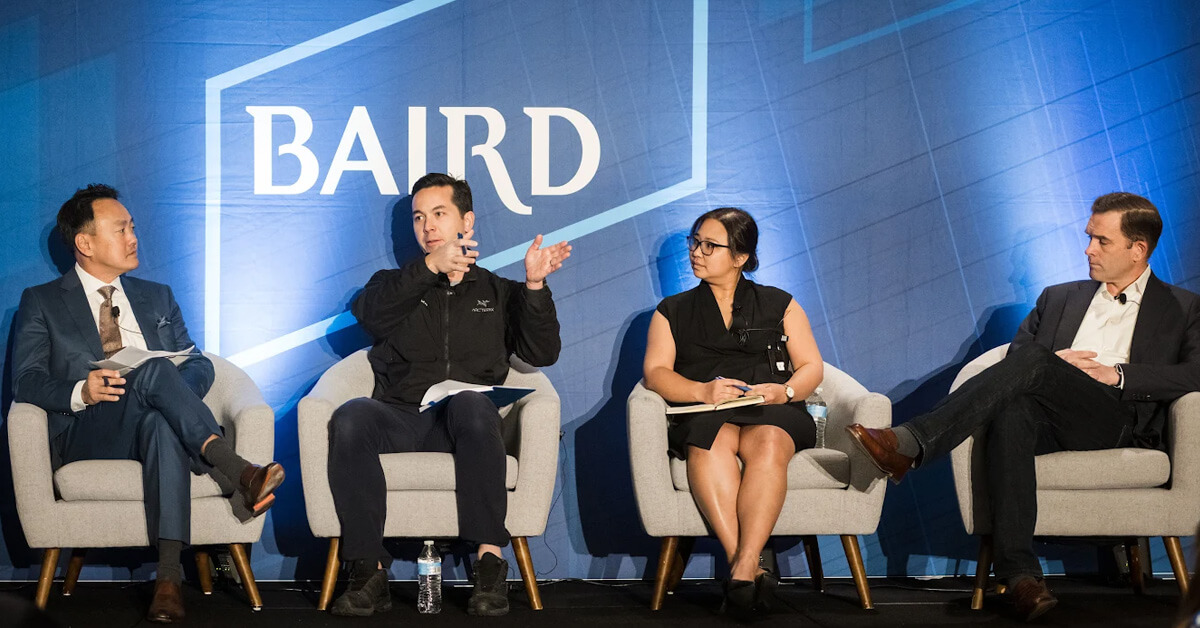
Diem Salmon, vice president of air dominance and strike at Anduril—which Song and Stack said it presently valued at $30 billion in the public markets, rivaling that of a large prime many times its size—remarked that “the time has never been better for new entrants [such as defense tech companies] to work with” the Department of Defense.
Is Defense Tech Stable & Profitable Yet?
Salmon’s co-panelist on the Emerging “New” Primes panel, Shield AI Co-Founder and President Brandon Tseng, agreed, adding that “it’s never been easier for a company to raise capital to work for the [DOD].” But Tseng said that also means there’s more competition and that the “market’s never been noisier…separat[ing] the chaff from the noise” is the name of the game right now for DOD officials.
Salmon later in the conversation stipulated that while Anduril and other companies like it have made headway in gaining respect and are being taken more seriously by the DOD, they feel they have just gotten started.
“We haven’t completed the swing yet. So the department is not procuring anything at scale from a new entrant. They have let us in the door. We are working on prototypes and development efforts,” Salmon noted. “We are starting to get to fielding, but when we talk about production at scale—credible revenue business that actually shows an ROI…we have not actually gotten to that point where we’re saying we’ve created a healthy marketplace for new entrants to survive in the defense space.”
Traditional Primes Are Still Vital
Despite defense tech firms making noise, the conference also made clear that the large prime contractors are not a lost cause. On average, traditional government services companies were down 15.5 percent this year in the public market, Stack and Song cited, but they pointed to CACI and Leidos as two companies that were able to effectively weather the storm—and did so through improbable means.
Improbable because not only were traditional contractors’ valuations on a downward trend, so too were mergers and acquisitions deals, Baird’s bread and butter (the company advises GovCons on many such deals). Stack described 2025’s as a “really lackluster M&A environment,” reportedly down 11 percent in deal volume from last year and “even more on the private equity side.”
Nonetheless, the Baird pair praised CACI and Leidos as overcoming these obstacles — the former was up 46 percent this year and the latter 33 percent. The two massive companies responded to the challenges of tightening government budgets by getting more aggressive on inorganic growth. In the last few years, CACI has completed 27 transactions at $4.7 billion and Leidos has invested in nine companies at a total $3.9 billion price tag. Rather than deepen their expertise and capabilities in areas they were already proficient in, Stack and Song said the companies acquired organizations in areas they didn’t have as much authority, such as signals intelligence for CACI and hypersonic missiles and directed energy for Leidos, in order to solidify their place as one-stop-shops for federal agencies.
Are Analysts Underrating Big Primes’ Market Value?
Acknowledging skepticism about big primes voiced by Baird aerospace and defense senior research analyst Peter Arment during his A View from Wall Street yearly lunch session, Carlyle Group senior advisor and industry veteran Frank Finelli nonetheless suggested that analysts underestimate the market demand for traditional government services.
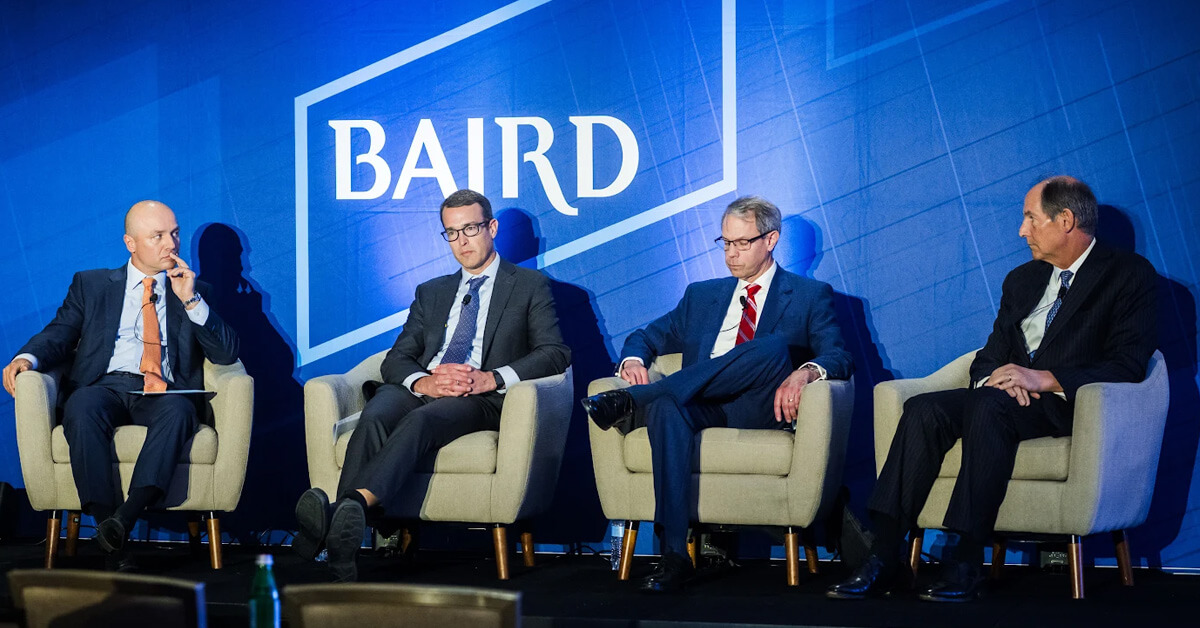
“The big primes are not quite luddites, if you will, and whether defense tech takes over the world or not—time will tell,” Finelli stated during the Market Perspectives From Defense Leaders panel, which he moderated.
Contributors to that panel hailing from RTX, Northrop Grumman and L3Harris reinforced Finelli’s stance and said they’re partnering with new entrant defense tech firms as much as possible. RTX recently announced a partnership with Shield AI and Northrop is fostering an investment arm that targets up-and-coming players and has also linked up with Palantir and Anduril.
GovCons Must Prioritize R&D
Part and parcel of the surge in defense tech is a renewed focus on research and development in the private sector. Event speakers such as Peter Arment argued that big primes must direct more of their budget toward independent R&D, or IRAD, if they want to have a chance of competing with big primes. Arment said two percent of budget spent on IRAD “isn’t going to cut it” in the current defense-tech-centric environment.
AV easily eclipses this; they said their products business is investing 15 percent of annual revenue into IRAD. During the “New” Primes panel, Church Hutton, chief growth officer at AV, said that the defense tech industry wants to move “some of” the risk associated with developing new and untested products off of government and the taxpayer and onto industry.
Pushing back against the idea that big primes aren’t spending the necessary funds on IRAD was Bruce Stephenson, vice president of corporate strategy and technology at Northrop Grumman, who said that the company has spent over $13 billion on R&D and production capacity.
To learn more about partnering with the DOD on innovative tech R&D, make sure you register and mark your calendar for Potomac Officers Club’s 2026 Defense R&D Summit on Jan. 29. Under Secretary of Defense for Research and Engineering Emil Michael will be a keynote speaker.
Best Ways to Get R&D Technologies to Market
The methods contractors are using to get nascent technologies from research and development and past the “valley of death” to warfighters’ hands was a constant theme at the Baird Defense and Government conference. Van Gurley, Metron president and CEO and 4×24 member, embraces partnerships because they allow his company to field technologies without the huge financial expense of setting up manufacturing.
“My company is mostly a software house. What has been interesting for us, since we’re too small to bring to market vertical solutions, we use a partner model,” Gurley said. “[We have partnered] with a Canadian company that let us bring novel prototypes out for demonstration and evaluation. We use a clean sheet approach and I took a page from Anduril: software first.”
Tony Frazier, LeoLabs CEO, Wash100 winner and 4×24 member, provided insight into the company’s contracting strategy and how it helps LeoLabs advance R&D technologies.
“As we incubate new technology, we have leveraged the [Small Business Innovative Research] program. We have two SBIR Phase 2 programs,” Frazier said. “We were able to partner with both SpaceWERX and Space Systems Command on a transition plan. We have strong support to help these capabilities fill key gaps. We have [Air Force] [Strategic Funding Increase] awards as well.”
AI Continues to Grow as a Major Focus
How contractors were leveraging AI was a common theme at the Baird 2025 Defense and Government Conference. Representatives from both established contractors like KBR and startups such as Parry Labs talked about how AI investments were key to their work.
During a company presentation, JD Parkes, Parry Labs CEO and co-founder, Wash100 Award winner, and 4×24 member, discussed how developing AI infrastructure to serve as the digital “plumbing” for aircraft is a key focus of Parry Labs. He also discussed how Parry Labs using AI to modify legacy unmanned aerial vehicles like MQ-1 Predators and MQ-9 Reapers and make them cutting-edge aircraft in modern warfare.
“We’re investing in a core operating system called Stratia which provides digital plumbing and creates enterprise software tools to go from a digital engineering environment to end software OS that can be hosted and enable other apps,” Parkes said. “We’ve focused on the advanced AI computing that is needed to stay ahead in those spaces.”
Elsewhere, during a KBR organizational showcase, Gabe Camarillo, KBR senior vice president for defense technology solutions and fellow 4×24 member, discussed how the company is using AI services to reduce costs for customers.
“Aviation is a huge area of spending for DOD. Not only for new aircraft and capabilities but also in maintaining legacy platforms,” Camarillo said. “Using advanced tools like AI, we’re reducing sustainment costs in the Navy, which is [also] an area of significant spending for both DOD and the Navy.”
International Partnerships Are Being Centered
Speakers throughout the day mentioned the value of international partnerships to growing their defense businesses. Frazier discussed how the creation of the U.S. Space Force in 2019 coincided with other militaries creating their own space divisions and how that created business opportunities.
“We’ve had to build a strong core business leveraging our unique assets. We’ve been able to build relationships with international allies,” Frazier said. “When the Space Force stood up, many allies built their military commands and, at that time, we were able to build a business around those customer segments. That helped us scale our DOD business to where we are not only growing, but profitable.”
In the State of the Market address, John Song discussed how evolving security priorities in Europe and reduced investment from the U.S. has European nations investing heavily in military technologies.
“The European markets are growing and they will continue to grow. That market is going to be in the national security space,” Song said. “For NATO, non-U.S. [spending] will be $1.5 trillion by 2035. It’s significant, so, there’s a lot of opportunities. European companies are starting to jockey for a better positions in that market accordingly.”